Domestic & Commercial Water Tank Cleaning Services Across the UAE
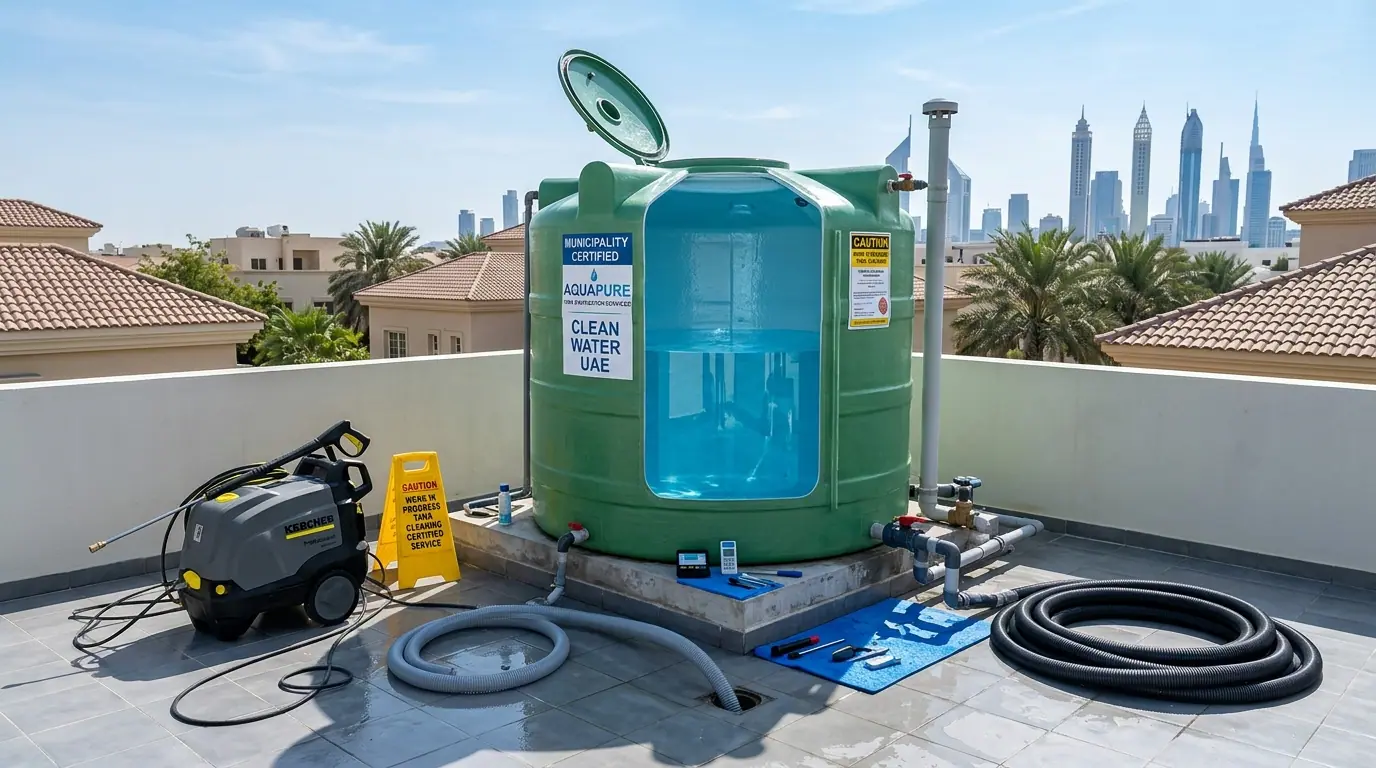
Take care of the water used in your home and reduce the sediment, algae, and odors that build up inside storage tanks. We provide drainage, mechanical scrubbing, and food-grade disinfection for GRP, polyethylene, and concrete underground and rooftop water storage tanks, following clear and carefully planned steps.
- High-capacity submersible pumps to remove silt, sludge, and biofilm
- Mechanical and pressure-washer scrubbing to remove slimy algae and bacterial layers
- Food-grade sodium hypochlorite disinfection at a controlled concentration
- DPD residual chlorine measurement before refilling and restarting the system
Planned Food-Grade Disinfection
Food-grade sanitizing solution at a calculated concentration, followed by repeated rinsing.
Heavy Submersible Sludge Pumps
Fast removal of large volumes of sediment and silt without clogging your plumbing.
Experienced GRP & Concrete Tank Care
Non-abrasive methods that protect interior gelcoats and waterproofing linings.
Before & After Photos
We photograph the tank before and after cleaning and walk you through any observations.
Why Regular Water Tank Cleaning Is Recommended in the UAE Climate
Residential and commercial properties across the United Arab Emirates depend on dual water storage systems: an underground concrete or GRP transfer reservoir receiving municipal water, and rooftop storage tanks distributing water by gravity or booster pumps to kitchens and bathrooms. While water reaches the building from the public network, letting it sit in enclosed domestic tanks under summer temperatures that can exceed 45°C creates conditions that favor algae growth, bacteria, and sediment buildup.
Over months of use, fine desert silt filters past loose access covers and vent pipes, settling into a dense mud layer at the bottom of your tanks. In the intense heat, this sediment can support the growth of algae, bacteria, and a slimy biofilm on the internal tank walls. Uncleaned tanks can affect water clarity, taste, and odor, and can clog filters and fixtures, which is why periodic cleaning is recommended to keep household water clean.
Nojoom Al Azm provides a structured water tank cleaning and sanitization service. We do not merely open a drain valve and rinse with a hose; our trained technicians enter the tank with the appropriate safety equipment to pump out the sludge, pressure-wash internal surfaces, apply a food-grade disinfectant that helps reduce bacteria and pathogens, and perform multi-stage rinse cycles and DPD chlorine measurements before restoring water to your home. If you would like water-quality testing, it can be arranged separately through an accredited lab.
Who Requires Regular Water Tank Sanitization
Private Residential Villa Owners
Keeping the water used by children and elderly family members for bathing, laundry, and daily needs clean and clear.
Newly Handed-Over & Renovated Properties
Flushing out construction dust, PVC adhesive residues, and cement debris before the domestic taps are used.
Restaurants, Cafés & Commercial Kitchens
Regular tank cleaning helps keep the water used for cooking and food preparation clean, with water-quality testing through an accredited lab available on request.
Residential Apartment Buildings & Compound Facilities
Preventive maintenance for large shared tanks to help keep water clean for many residents and reduce abrasive silt damage to booster pumps.
Common Water Tank Problems and How Our Process Addresses Them
Our procedure targets the common causes of sediment buildup and declining water quality in your home:
Thick Mud, Rust, and Desert Silt Settling in the Base of Storage Tanks
Heavy-duty submersible sludge pumps evacuate heavy mineral sediment, followed by wet vacuuming to leave the floor spotless.
Algae Blooms, Microbial Biofilms, and Musty Stagnant Water Odors
High-pressure washing and food-grade oxidizing disinfectant help remove biofilm and algae and limit their return.
Changes in Water Taste, Odor, or Appearance During Showers and Daily Use
Removing sediment and algae from the tank and rinsing it thoroughly helps deliver cleaner, less odorous water.
Frequent Clogging of Faucet Aerators and Water Heater Filters
Removing sand and particulates at the storage tank source reduces the amount of silt reaching household pipes.
Unnoticed Waterproofing Cracks in Underground Concrete Tanks
A post-cleaning visual inspection checks epoxy coatings for visible cracks that could allow groundwater to seep in.
Want us to price this for you now?
Send us the size and location and we will reply with a clear quote before any commitment.
Comprehensive Scope of Work: Water Tank Cleaning and Disinfection
A clear, step-by-step procedure applied to both underground and rooftop tanks:
Underground Water Reservoirs (Concrete & GRP)
- Electrical isolation of transfer booster pumps and closure of mains supply valves
- Confined-space safety air testing and mechanical ventilation deployment before technician entry
- Submersible pumping evacuating sediment slurry down to the lowest sump pit floor
- High-pressure rotary washing (150 Bar) of all internal walls, roof soffits, and access ladder rungs
Rooftop Distribution Storage Tanks (GRP & Polyethylene)
- Inspection of outer inspection manhole gaskets, vent pipe insect mesh screens, and structural lid integrity
- Complete water evacuation and soft-scrubbing of interior GRP surfaces to remove thermal algae blooms
- Mechanical agitation of tight vertical corner seams and perimeter internal float valves
- Sanitization of high-level ballcock shutoff assemblies and overflow drainage screens
Distribution Lines, Booster Pumps & Suction Strainers
- Flushing of low-level tank outlet nozzles to purge settled rust scale and debris
- Clearing inline Y-strainers and pump intake filter meshes of trapped stones and plastic shavings
- Controlled pressure flushing through primary domestic riser pipes to dislodge stagnant line water
- Inspection of non-return check valves to ensure zero reverse water siphoning
Disinfection, Field Checks & Handover Summary
- Application of food-grade sodium hypochlorite solution with a controlled contact dwell time
- Multi-stage fresh water rinsing cycles to dilute and remove sanitizer residue
- Colorimetric DPD field test to monitor that free residual chlorine falls below 0.5 ppm
- A service summary with before-and-after digital photographs
Our 6-Stage Water Tank Cleaning and Sanitization Process
A clear, safety-focused procedure we follow on every tank:
Safety Isolation, Gas Detection & Ventilation Setup
We isolate supply valves, lock out booster pumps, and conduct atmospheric gas testing on underground tanks, deploying forced-air blowers to protect technician safety.
High-Capacity Submersible Sludge Evacuation
Retaining a small water layer, we lower industrial vortex sludge pumps to vacuum out thousands of liters of silt, sand slurry, and dissolved impurities.
Mechanical High-Pressure Surface Decontamination
Technicians enter the tank in waterproof protective suits, using 150-bar pressure washers and soft nylon brushes to strip biofilm and algae from walls and ceilings.
Complete Slurry Recovery & High-Vacuum Extraction
Residual wash-water containing stripped biofilm is completely vacuumed out with industrial wet extractors, leaving the bare tank floor dry and free of particulate debris.
Food-Grade Disinfection (Controlled Dwell Time)
A food-grade sodium hypochlorite solution (calibrated to 50–100 ppm free chlorine) is sprayed over all surfaces and left to dwell to help reduce bacteria and microbes.
Fresh Water Rinse, DPD Chlorine Verification & Refill
The tank is thoroughly flushed with clean water. We measure free chlorine with a digital DPD photometer to check it has dropped below 0.5 ppm, then refill and reactivate the booster pumps.
Professional Equipment & Disinfectants We Use
We use commercial-grade equipment suited to cleaning water storage tanks:
Heavy-Duty Submersible Sludge & Sump Pumps
Pumps water heavily laden with sand, silt, and rust fragments without impeller jamming.
Kärcher Commercial 150-Bar High-Pressure Washers
Blasts pressurized water jets stripping tenacious microbial biofilms from GRP and concrete.
Food-Grade Sodium Hypochlorite Disinfectant
Oxidizing disinfectant widely used to help reduce bacteria and algae, and rinsed thoroughly from the tank after application.
Electronic DPD Colorimetric Chlorine Photometers
Measures residual free chlorine at low concentrations in the field.
Full Tank Cleaning vs. Basic Drain-and-Rinse
See the difference between a complete cleaning and disinfection procedure and simply draining and rinsing the tank from outside:
| Evaluation Factor | Nojoom Al Azm Full Cleaning | Basic Drain-and-Rinse |
|---|---|---|
| Internal Physical Entry | Trained technicians enter in protective suits to scrub all walls and sumps | Rinses from outside the lid, so wall biofilm may remain |
| Sanitizing Chemistry | Food-grade sodium hypochlorite at a calculated ppm, followed by repeated rinsing | Household detergent or laundry bleach can leave foam and residue in the tank |
| Sludge Removal Method | Submersible vortex pumps remove heavy silt to outside drains | Mud may be pushed into outlet pipes and clog household fixtures |
| Post-Cleaning Checks | DPD field measurement of residual chlorine, with pH and turbidity readings | Refilled without measuring, so chlorine traces may remain in the taps |
| Confined Space Safety | Electronic 4-gas monitors and forced-air blowers | Entering underground tanks without safety equipment is risky |
Water Tank Sanitization Protocols Across UAE Property Types
Customized service schedules tailored to storage capacities and property layouts:
Private Residential Villas (Underground + Rooftop Tanks)
Synchronized cleaning of both tanks to prevent cross-contamination across the domestic plumbing loop.
Service twice a year (every 6 months) to help maintain water clarity and quality.
Newly Completed Villas & Post-Renovation Sites
Purging construction gypsum, airborne sawdust, and plumbing solvent residues before initial occupancy.
Deep cleaning and sanitization before move-in is recommended, ahead of unpacking personal belongings.
Multi-Family Residential Compounds & Tower Reservoirs
Massive concrete subterranean reservoirs, staged section isolation, and coordinating minimum water disruption.
Scheduled bi-annual maintenance with temporary bypass pumping ensuring continuous tenant supply.
Restaurants, Cafeterias & Commercial Food Outlets
Keeping a regular cleaning schedule and photo records of each service, with water-quality testing through an accredited lab available on request.
Quarterly cleaning schedules to help keep tanks clean.
A question before you book?
Message us on WhatsApp with your situation and we will suggest the best option, no obligation.
What Determines the Price of Water Tank Cleaning in the UAE
Clear quotations based on storage volume and tank specifications, provided in writing before work begins:
Total Tank Storage Volume (Gallons or Cubic Meters)
Standard pricing scales logically according to capacity (e.g., 1,000 gal, 2,000 gal, 5,000+ gal commercial reservoirs).
Tank Material & Construction Type (GRP vs. Concrete vs. Poly)
Large concrete underground reservoirs require heavier pressure washing and safety air handling compared to poly rooftop units.
Dual-Tank Villa Package (Both Underground & Rooftop Tanks)
We may offer a reduced bundled rate when both the lower reservoir and upper rooftop tank are sanitized during the same visit.
Manhole Access & Structural Accessibility
Deep confined-space tanks requiring specialized rope tripod access and forced ventilation systems.
Clear pricing
Our written quotation states what is included, such as submersible pumps, food-grade sanitizers, safety gear, DPD field checks, and a photo summary, so everything is clear before we start.
Structural Safety Standards: Protecting Tank Linings & Pumps
We handle every water tank with care to help prevent structural damage:
Glass Reinforced Plastic (GRP) Sectional Tanks
Soft nylon bristle brushes and pressure washer nozzles kept at calibrated distances; zero wire brushes.
Protects the smooth interior food-grade gelcoat from micro-fissuring and fiber exposure.
Epoxy-Lined Concrete Underground Water Reservoirs
Pre-cleaning coating inspection; non-abrasive chemical washes that avoid peeling intact membrane.
Preserves the waterproof barrier, preventing groundwater contamination or structural leaks.
Electrical Float Switches & Submerged Sensors
Float sensors are secured safely away from pressure jets and technician foot traffic.
Helps keep automatic pump shutoff and filling cycles working reliably after the system restarts.
External Vent Pipes & Access Manhole Covers
Fine-mesh anti-insect gauze is cleaned and refitted; manhole lids are securely latched.
Prevents desert sand, insects, and birds from re-contaminating the fresh water.
Helpful Steps Before Our Water Tank Cleaning Team Arrives
Ensure an efficient service session while minimizing water waste:
- 1Reduce water consumption 12 to 24 hours prior to allow the tank level to naturally drop, minimizing water disposal.
- 2Store a modest volume of domestic water in clean buckets or pots for essential home needs during the service window (typically around 2 to 4 hours).
- 3Ensure clear vehicular access near the underground tank access hatch so discharge hoses can be connected efficiently.
- 4Provide a nearby operational electrical outlet to power our submersible pumps and high-pressure washers.
Post-Cleaning Tips for Domestic Water Systems
Keep your water clean and clear for months to come:
- Open cold water taps for approximately one minute post-refill to flush out any trapped air pockets from household plumbing.
- Ensure the rooftop tank access lid is locked tightly in place to prevent wind-borne sand infiltration.
- Rinse shower head filters and faucet aerator screens to dislodge any residual scale loosened during pipe repressurization.
- Mark your calendar for the next recommended 6-month sanitization cycle to keep water quality consistent.
Dangerous DIY Water Tank Cleaning Mistakes to Avoid
Steer clear of these practices that can affect domestic water quality and safety:
Can leave surfactant foam and chemical residues that mix with bathing and household water for a long time.
Use food-grade sodium hypochlorite at a calculated parts-per-million dose, with thorough rinsing and a residual chlorine check.
Presents a serious risk of asphyxiation due to oxygen depletion and trapped gas pockets in underground sumps.
Never enter tanks without electronic gas detectors, mechanical blowers, and safety harnesses; use a trained team.
Sludge and bacteria can build up unseen at the bottom of the tank even when tap water looks clear.
Clean the tank about every 6 months to once a year, depending on its condition and usage.
Nationwide Water Tank Cleaning Across All 7 Emirates
Our mobile teams, equipped with sludge pumps and disinfection equipment, serve communities across the UAE:
Comprehensive coverage: Dubai Hills, Palm Jumeirah, Arabian Ranches, Al Barsha, Nad Al Sheba, Al Khawaneej, and Jumeirah.
Prompt service in: Saadiyat Island, Yas Island, Al Raha Beach, Khalifa City, Mohammed Bin Zayed City, and Al Bateen.
Daily service across: Al Rahmaniya, Al Suyoh, Muwaileh, Al Qarayen, Al Khazamiyah, and Al Majaz.
Serving: Al Jurf, Al Rawda, Al Rashidiya, and Al Yasmeen.
Serving residential villas and developments in Al Salamah, Falaj Al Mualla, and Al Raafa.
Care for estates and villas in Khuzam, Al Dhait, Al Hamra Village, and Al Rams.
Dedicated services in Al Faseel, Dibba Al Fujairah, and coastal residential communities.
Frequently asked questions
We generally recommend professional water tank cleaning and disinfection about every 6 months (twice a year), though this can vary with the tank condition and usage. The intense regional heat and airborne sand can speed up biofilm formation and sediment buildup compared with cooler climates.
A standard villa with one underground and one rooftop tank typically takes between 2 to 4 hours. This includes complete evacuation, mechanical pressure scrubbing, food-grade disinfection dwell time, and multi-stage rinsing.
Yes, the domestic water supply will be temporarily turned off while our team is actively scrubbing and sanitizing the tanks (typically a few hours). We advise customers to store a small amount of water for essential domestic tasks before we begin.
We use food-grade sodium hypochlorite, a disinfectant widely used for water chlorination. After disinfection, tanks are flushed multiple times and measured with a digital DPD photometer to check that chlorine levels have dropped below 0.5 ppm before refilling. If you would like water-quality testing, it can be arranged separately through an accredited lab.
Yes. Our supervisor photographs the interior walls and base before treatment, during mechanical washing, and after disinfection. We send a digital summary with the photos, our field readings, and any structural observations.
Yes. Once the underground tank is evacuated and bone-dry, our technicians visually inspect the structural walls and epoxy lining for visible cracks or groundwater seepage and let you know if repairs seem necessary. This does not replace a specialist engineering inspection where one is needed.
Recommended Sister Services
Holistic packages ensuring complete hygiene across every aspect of your property.
Villa & Estate Deep Cleaning UAE
Comprehensive cleaning solutions engineered for multi-story villas and luxury estates.
Comprehensive Deep Cleaning UAE
Thorough corner-to-corner cleaning, kitchen degreasing, and surface polishing.
Targeted Pest Control Services UAE
Pest treatments and preventative barriers to help protect home perimeters.
Professional Home Cleaning UAE
Structured residential care ensuring clean, healthy living environments for UAE families.
This service in UAE cities
Dedicated pages for each city, explaining the service for the local property types and climate.
Cleaner Water for Your Family After Tank Cleaning and Disinfection
Get rid of sediment and built-up algae in your home tank today. Schedule your water tank cleaning and disinfection service with Nojoom Al Azm anywhere in the UAE.