Bed Bug Control Services Across the UAE
A multi-stage methodology targeting adult bed bugs, emerging nymphs, and sheltered egg caches deep within mattress seams and furniture joints, aiming to break the reproductive cycle.
- Close physical inspection with magnification and lighting of mattress seams, box springs, and upholstered headboards
- Dual-action treatments targeting active insects and developing egg cycles
- Clear room preparation guidance to help limit cross-room spreading and furniture loss
- Clear distinction between domestic mattress steam cleaning and specialized bed bug treatment
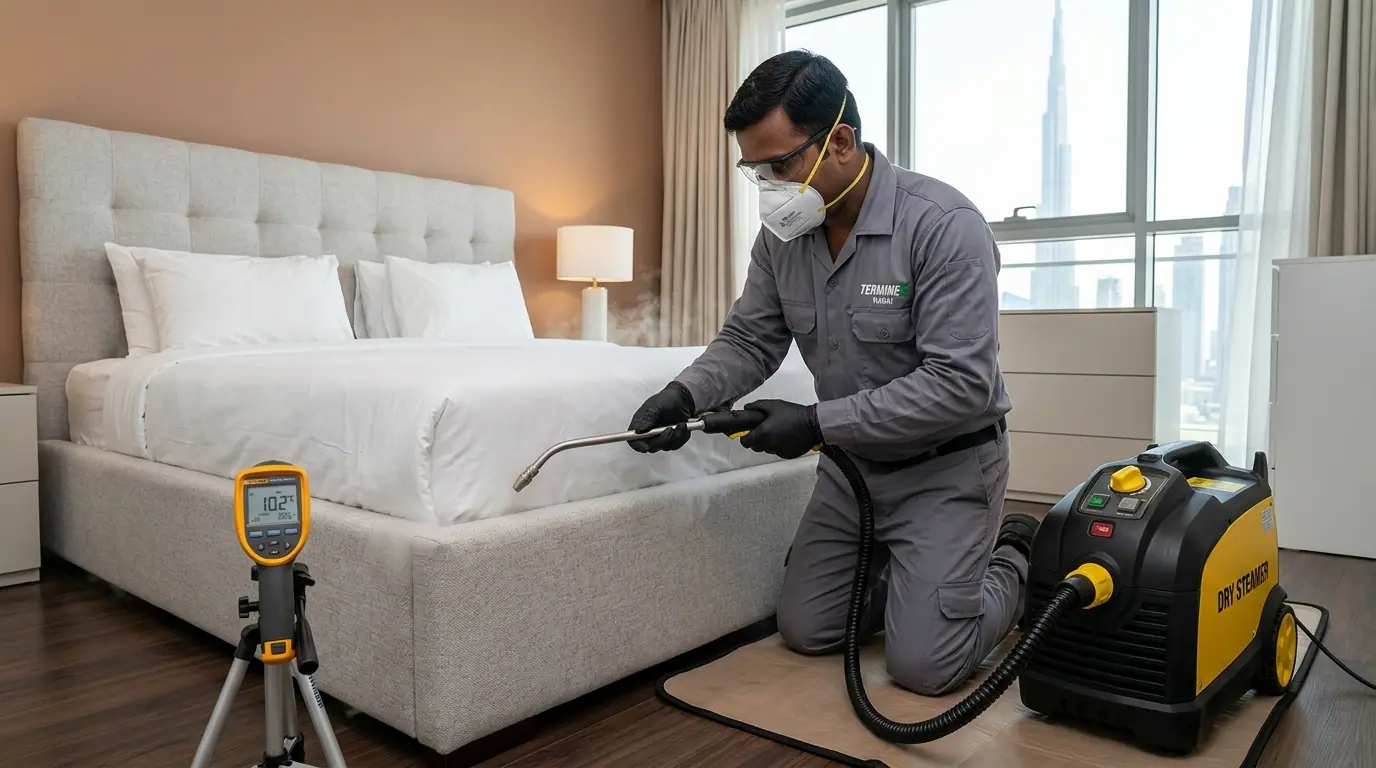
Physical Diagnostics
Thorough inspection of biological evidence rather than relying solely on bite assumptions
Egg Interception
Specialized formulations targeting concealed niches to help reach developing nymphs
Furniture Preservation
Technical protocols that aim to preserve mattresses and upholstery without disposal in most cases
Follow-Up Visit
A follow-up visit after roughly 10 to 14 days is recommended to review results and monitor egg hatching
Biological Dynamics of Bed Bugs (Cimex lectularius)
Bed bugs are among the most stressful domestic pests encountered in urban residential environments across the United Arab Emirates. Small, oval, wingless, and dorsoventrally flattened, their reddish-brown bodies allow them to harbor within crevices no thicker than a standard credit card (less than one millimeter). What makes bed bugs challenging to control is their ability to survive several months without a blood meal and their documented resistance to many conventional retail insecticides. A single fertile female deposits hundreds of micro-adhesive eggs deep inside wooden bed frame joints and structural fabric folds, which calls for a careful, often multi-visit strategy.
Bite reactions vary dramatically between individuals and closely resemble mosquito or flea bites; bites alone cannot definitively confirm an infestation without physical evidence
Insects harbor within a close radius of sleeping human hosts, emerging strictly during dark hours for rapid feeding before retreating into concealment
Bed bugs are passive hitchhikers transported via luggage, international travel items, and second-hand furniture, but they do not jump or fly
Standard residential mattress cleaning is aimed at stains and dust mites; active bed bug infestations usually require specialized treatment
Infestation Stages & Spatial Dispersal Profiles
Our technicians assess the exact colonization stage to plan treatment scope and containment boundaries:
Early-Stage Localized Incursion
Confined to a single mattress seam, bed slat joint, or headboard corner, typically introduced via recent travel luggage. Generally easier to control when intercepted promptly.
Established Room-Scale Infestation
Insects have migrated from the mattress into the box spring structure, bedside nightstands, baseboard gaps, and adjacent wall electrical socket receptacles.
Complex Multi-Room Dispersion
Spread across multiple bedrooms, living room upholstered sofas, and corridors, frequently triggered by moving contaminated bedding or improper retail chemical spraying.
Want us to price this for you now?
Send us the size and location and we will reply with a clear quote before any commitment.
Physical Evidence of Active Bed Bug Colonization
Prior to initiating chemical interventions, our technicians look for physical evidence on-site:
1Dark Fecal Spots Along Mattress Seams (Fecal Spotting)
Digested blood excreted by bed bugs leaves distinct black or dark-rust spots that look like tiny ink dots bled into fabric fibers along piping seams, which do not rub off easily.
2Minute Blood Smears on White Bed Sheets & Linens
Restless occupant movement during sleep may crush newly engorged bugs, leaving faint rusty streaks or small red smears on light-colored bed linens.
3Translucent Molted Exoskeletons (Cast Skins)
As nymphs progress through five developmental instars, they shed their outer chitinous cuticle. These pale, hollow, straw-colored casings accumulate in deep frame joints.
4Direct Sighting of Live Adults or Cream-Colored Eggs
Spotting live, apple-seed-sized brown insects hiding along mattress seams or observing microscopic, rice-shaped white eggs glued in clusters inside wood joints.
5Faint Sweet, Musty Pheromone Odors in Advanced Cases
Large, established colonies produce a distinct sweet, sickly, musty odor emitted by alarm scent glands, often compared to rotting raspberries or damp coriander.
Primary Harborage Zones Inspected by Our Technicians
Bed bugs harbor in dark, narrow structural voids located within close proximity to human hosts:
Mattress Piping Seams, Tufting Crevices & Corner Labels
The primary harborage where adult insects rest and females deposit micro-adhesive eggs within tight fabric folds.
Box Spring Interior Framework & Bottom Dust Cover Mesh
The hollow interior provides an ideal dark sanctuary; bugs harbor along wooden frame corners and inside staple recesses.
Upholstered Headboards & Structural Mounting Brackets
The narrow void between the wall and headboard provides an undisturbed refuge completely shielded from daily household cleaning.
Perimeter Baseboard Crevices & Carpet Tack Strips
Gaps beneath wooden skirting boards provide linear transit routes allowing bugs to navigate the room perimeter.
Electrical Wall Outlet Receptacles & Switch Plates
Hollow wall cavity boxes serve as daytime hiding spots and potential conduit highways into adjoining rooms.
Nightstand Drawer Glides & Rear Joint Voids
Wooden drawer dovetails, screw holes, and rear panels adjacent to the bed frequently harbor small secondary clusters.
Why Self-Treatment & Retail Insecticides Often Fall Short
Attempting to control bed bugs with over-the-counter sprays can often worsen the infestation:
Documented Pyrethroid Chemical Resistance
Many modern bed bug populations in urban centers show significant physiological resistance, producing enzymes and thickened cuticles that can make retail aerosols far less effective.
Aerosol Repellency & Building-Wide Dispersal
Consumer bug sprays emit airborne vapors that startle bed bugs without killing them, prompting the colony to scatter through electrical conduit boxes and baseboards into adjacent rooms.
Limited Impact on Shielded Eggs
Bed bug eggs are insulated by tough chorionic membranes that standard liquid contact sprays may not penetrate, and they typically hatch new hungry nymphs 7 to 10 days later.
Cross-Contamination from Moving Bedding
Carrying infested comforters or shifting mattresses into other rooms dislodges eggs and live bugs into hallways, contaminating previously pristine living zones.
Our Comprehensive 5-Stage Bed Bug Control Protocol
A systematic intervention designed to target all lifecycle stages from egg to reproducing adult:
Diagnostic Examination & Boundary Mapping
High-intensity optical inspection of mattress seams, frame joints, and surrounding perimeter fixtures to evaluate infestation severity and boundary limits.
Precision Crack & Crevice Void Applications
Applying specialized non-repellent residual formulations and desiccant dusts directly into mattress seams, bed joints, and baseboard voids.
Electrical Cavity & Perimeter Barrier Proofing
Treating electrical wall plates adjacent to sleeping zones with specialized dust formulations, establishing chemical barriers to stop inter-room transit.
High-Temperature Laundry & Encasement Advisory
Instructing clients on thermal laundering protocols for bed linens and recommending bed bug mattress encasements.
Recommended Follow-Up Visit (10-14 Days)
An important part of our protocol: depending on the case, technicians return after 10 to 14 days to inspect monitoring points and treat any newly hatched first-instar nymphs.
Room Preparation Guidelines Prior to Technical Service
Following these preparation instructions helps limit cross-room contamination and supports treatment results:
- Please do not move mattresses, pillows, or furniture out of the infested room into hallways or other bedrooms; doing so spreads bugs throughout the house.
- Strip all bed sheets, blankets, and pillowcases, placing them immediately into heavy-duty plastic garbage bags inside the bedroom before transport.
- Launder bagged bedding in hot water (minimum 60°C) or tumble dry on high heat for at least 30 minutes to help eliminate bugs and eggs through heat.
- Empty bedside nightstand drawers and clear floor perimeters around the bed to provide unhindered access to baseboard moldings.
- Pull the bed frame approximately 50 centimeters away from the wall to permit thorough inspection of headboard mounting brackets.
Post-Treatment Safety & Maintenance Guidelines
Follow these instructions to help preserve treatment results and look after your family:
- Follow the room ventilation period specified by your technician based on product label instructions.
- Do not wipe down, scrub, or steam-clean treated baseboard crevices or frame joints; doing so removes the vital residual barrier.
- Install high-quality bed bug proof mattress and box spring encasements after the service to seal off internal fabric voids.
- Where a follow-up inspection is arranged after 10 to 14 days, please take part; it helps review egg hatching and results.
- Contact Nojoom Al Azm technical support if you notice unexpected insect movement outside the treated perimeter.
A question before you book?
Message us on WhatsApp with your situation and we will suggest the best option, no obligation.
Bed Bug Management Across Varied Structural Typologies
Different building designs present unique containment and transit challenges:
Targeted bedroom isolation focusing on shared electrical conduits, plumbing shafts, and baseboard perimeters separating adjacent flats.
Comprehensive multi-bedroom audit including domestic staff quarters, with synchronized laundry and thermal treatments.
Rapid containment protocols addressing the target room and adjacent barrier units (adjacent, above, below) with discretion and respect for guest privacy.
Nojoom Al Azm Protocol vs Surface Spraying Alone
| Evaluation Parameter | Nojoom Al Azm Comprehensive Protocol | Surface Spraying & DIY Treatment |
|---|---|---|
| Diagnostic Depth | Close inspection checking fecal spotting, cast skins, and egg caches in joints | Quick check of the mattress followed by surface liquid spraying, often without wider inspection |
| Lifecycle & Egg Interception | Multi-stage intervention with a follow-up visit, depending on the case, targeting newly emerged nymphs | A single treatment may affect exposed adults but may not reach eggs, which can hatch into a renewed infestation |
| Furniture Conservation | Treatment that aims to keep mattresses and headboards in most cases, following safety guidance | Some people discard costly mattresses and furniture without first trying targeted treatment |
| Dispersal Management | Non-repellent formulations and clear containment guidance to help limit room cross-spread | Repellent aerosol sprays may scatter bugs into living rooms and adjacent bedrooms |
Key Factors Governing Bed Bug Control Pricing
Nojoom Al Azm prices bed bug services transparently based on technical scope and room dimensions:
Number of Affected Bedrooms & Beds
Treating a single isolated bedroom requires different labor and material volume than a multi-room residential unit.
Colonization Severity & Structural Dispersal
Early-stage incursions localized to a single mattress seam require less labor than chronic multi-furniture infestations.
Furniture Construction & Headboard Typology
Deep-tufted upholstered fabric headboards require extensive detailing compared to minimalist wooden or metal frames.
Scheduled Follow-Up Treatment Window
We explain upfront whether the recommended 10-14 day follow-up visit is included in your quote, so you know what to expect.
Indicative Pricing Estimate
Transparent rates start from standardized single-bedroom packages, with exact quotations confirmed upon reviewing property details.
Each quote from Nojoom Al Azm explains what is included, such as diagnostic inspection, treatment materials, and the agreed follow-up visit, with no hidden fees.
Essential Habits to Keep Bed Bugs Out of Your Home
Inspect Hotel Bedding When Traveling
Pull back hotel bed sheets and examine mattress seam piping for black fecal spots before placing luggage on the bed.
Keep Luggage Elevated on Racks
Store suitcases on elevated luggage stands or in the bathroom rather than directly on hotel carpet or beds.
Quarantine & Inspect Second-Hand Furniture
Thoroughly examine second-hand wooden tables, chairs, and upholstered items with a flashlight before bringing them indoors.
Install Protective Mattress Encasements
Encase mattresses in smooth, bite-proof zipper encasements that reduce complex seam harborages and simplify early detection.
Restore Peaceful Sleep with a Clear Bed Bug Plan
Share your property details and observed infestation signs to schedule a specialized diagnostic inspection and tailored treatment plan from our trained specialists.
Everything you need to know about this service
In many cases, discarding your mattress and bed frame is not necessary; your technician will advise after inspection based on infestation severity and the condition of the furniture. Our protocols are designed to target fabric seams, tufting, and wooden joints to reduce live bugs and eggs, which may save you substantial furniture replacement costs.
Mattress cleaning is a hygiene service utilizing steam or hot water extraction to remove perspiration stains, odors, dead skin cells, and microscopic dust mites. In contrast, bed bug control is a specialized pest intervention targeting parasitic insects concealed deep inside structural bed frames, baseboards, and electrical wall boxes using specialized active formulations.
Bed bug eggs are naturally shielded by tough protein membranes that resist liquid contact sprays. These eggs typically hatch between 7 to 10 days post-treatment. The follow-up visit, arranged depending on the case, targets these newly emerged nymphs before they reach reproductive maturity and lets us review results with you.
Bite marks alone are not scientifically diagnostic because human immune responses vary wildly, and bites can easily be confused with mosquitoes, fleas, or contact dermatitis. Confirmation requires finding physical biological evidence: dark ink-like fecal spots along mattress seams, shed translucent cast skins, or direct sightings of live insects.
Yes, bed bugs migrate readily, most commonly through human actions like carrying contaminated comforters or shifting infested mattresses into other rooms. Additionally, using retail bug sprays can startle bugs, prompting them to disperse through baseboard crevices and electrical wall conduit boxes into adjacent bedrooms.
Related Pest Management Services
UAE Pest Control Services Hub
Overview of residential and commercial pest management
Targeted Cockroach Control Services
Specialized gel bait matrices for German and American cockroaches
Subterranean Termite Protection
Structural wood and foundation chemical barrier systems
Urban Rodent & Rat Management
Tamper-resistant bait containment and physical exclusion proofing
Distinguishing Mattress Hygiene from Bed Bug Treatment
If your primary concern is extracting perspiration stains, dust mites, and biological allergens from your mattress, explore our specialized steam sanitization service. For live insect infestations and bites, our bed bug protocol should be carried out first.
This service in UAE cities
Dedicated pages for each city, explaining the service for the local property types and climate.